Thursday, January 19, 2017
Media Blog Reflection
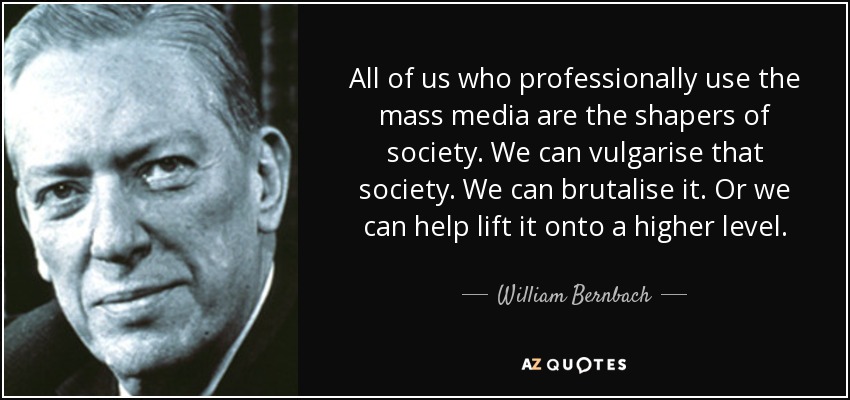
My view on media is pretty different than it was at the beginning of our media unit with a few exceptions. our media unit has made me realize just how much media we are bombarded with every single day. I also now realize how much goes into marketing and what techniques advertisers use to persuade consumers to buy more of their products. I also now realize the amount of deceit and misrepresentation that media includes. Important ideas such as how our society views women are determined by their portrayal throughout media. impressive statistics were shown throughout the media unit that made society's obsession with media very evident. Many statistics were shown that stated how many pieces of media teenagers are exposed to everyday and how much time teenagers spend on media everyday. I learned all about the techniques and methods that marketers use in order to sell to media consumers. I still believe that so many of these methods cannot work for everyone at the same time. I am very vulnerable to the need to nurture in advertisements especially when i am shown a dog or a cat because I love animals. Pretty much all other kinds of techniques are ineffective when trying to sell to me because I never really feel the need to aggress or be unique or affiliate with a certain crowd. I realize that these techniques are usually used to target specific audiences only because any technique wont work with absolutely everyone. I now understand the use of generic words and weasel words in advertisement that make the product sound better than it actually is. I think this unit was very important in order to understand the importance of correct representation in the media as well as becoming more informed about how media works and how to approach it. In this unit we were exposed to the example of women in media and how inaccurately the media portrays them. Women are viewed as objects rather than intelligent potential leaders. My media habits have changed because I can now look at marketing ploys for what they actually are. I am also aware of how much media I consume everyday and I have cut back on some of the social media and useless scrolling I used to do everyday. The amount of media I consume impacts my life because usually I am constantly sucked into the world of media and I waste a lot of time looking through social media and click bait articles and advertisements. I think that society's use and especially teenagers' use of media needs to change rather than believing that we should stop consuming media altogether because some of it is helpful. We need to shift our attention away from our obsession with celebrity lives and appearances, and instead become more informed about world events that really matter. Instead of actually paying attention to the news about Donald Trump, many people simply know about his tweets, which goes back to our obsession with celebrity lives and social media. I know that I like social media like most teenagers, but I am attempting to cut back on social media and become more in touch with political and social issues throughout the world in the news. I also understand that the news uses certain weasel words just like advertisers to make the issue discussed sound different. I understand that media distorts my perception of reality. Being an educated consumer helps you make more reasonable decisions and a healthy amount of skepticism helps you look deeper into an issue rather than believing everything as it is displayed on the surface. Through keeping my media blog, I realized that no matter what kind of media, there is always different sides to stories and that society needs to change its usage of media in order to create a more equal society, as well as a more well rounded view of different kinds of people as they are displayed in the media. I still believe that media is a very helpful tool and I am grateful to have access to it, but I do believe that I am more educated and can handle my usage of media in more well rounded ways.


Sunday, January 15, 2017
Blog Post About "Miss Representation" #2
One of the shocking statistics in Virgil Films' "Miss Representation" was that only 17% of congress is made up of women. The video made a point of showing how little people cared about the intelligence of a woman and how much people cared about the appearance of a woman. All anyone ever discussed during Sarah Palin's campaign was her looks. This should not be an issue that people discuss when choosing a leader. The video concludes that this is, in large part, because of how the media portrays women. Women are never really displayed in media for them to show their intellect but rather to flaunt their bodies or stunning facial features. This translates to real life because people are only ever focused on how a woman looks and when a woman decides to run for a political position, even though her intelligence and ideas should matter the most, people judge her ability to be in a position of power only based on how she looks. The video also stated that most of the opposition to women in positions of power is coming from other women. Women are constantly shown in the media that they should compete with one another and get into "cat fights" with each other. They are also never shown women in power so they believe that that is how it should be. Women are strongly effected by the presence of women in the media nd how they are presented because they are presented in superficial ways and therefore see themselves as objects that should be pretty to look at and that don't need intelligence.
Blog Post About "Miss Representation"
Virgil Films' "Miss Representation" addressed many problems regarding the lack of representation for women in the media and the issues that this creates for women in the real world. It presented an interesting statistic about the average teenager. It said that the average teenager spent 10 hours and 45 minutes on some form of media everyday. this was then used to show how harmful it the way that media portrays women is. It presented another statistic about women and girls with eating disorders. it said that about 65% of Women and girls have an eating disorder. They also said that depression rates among women and girls have almost doubled in women and girls from 2000 to 2010. This is caused by the amount of media that is consumed by women and girls everyday according to the video. Women are never shown realistic bodies in the media so they start to believe that women like themselves should have the bodies shown in the media that are regularly attained through Photoshop and are almost impossible standards to achieve. the video concluded that since teenage media usage won't decrease anytime soon, it is crucial to show more realistic bodies in the media to represent most of the population of women and girls. this way, the women and girls that consume media won't believe that they need to attain this impossible body standard that mainstream media today creates.
http://therepresentationproject.org/film/miss-representation/see-the-film/

http://therepresentationproject.org/film/miss-representation/see-the-film/

Sunday, January 8, 2017
Ketchup Advertisment

Blog Post About "Merchants of Cool"
Some of the main ideas presented in Frontline's "Merchants of Cool" were the different techniques used to advertise to teen males and teen females, and what teens find "cool." many reality assumptions that adults have about teens were revealed in the video. Companies use a "Mook" to advertise to teenage males based on the reality assumption that boys like loud obnoxious characters and a "midriff" to advertise to teenage females based on the reality assumption that girls are obsessed with appearance. This led to the question about if media influences teens or if teens influence media. It could be that the messages that media has sent have influenced teens and in turn, the behavior of teens influences the messages sent by media. Another reality assumption made by adults that was shown in this video was that teenagers like things that are undiscovered which shows the need for autonomy. At the same time, to be considered "cool," it is assumed that a teen should fit in a group and be admired which would show the need for affiliation. The dilemma that most companies face when trying to advertise to teens is that when the cool trend is used in advertising it is no longer considered "cool." It's often too difficult or expensive to keep up with trends because they change so fast and it's also difficult to tell what the new trend is sometimes. Some companies try to fix this problem by using correspondents or culture spies. Culture spies are in charge of answering the question of what is "cool" to teens. They do this by interviewing teens according to "Merchants of Cool." Many reality assumptions made about teens were revealed in Frontline's "Merchants of Cool," as well as various advertising techniques.
http://www.pbs.org/wgbh/pages/frontline/shows/cool/view/
http://www.pbs.org/wgbh/pages/frontline/shows/cool/view/
Subscribe to:
Comments (Atom)